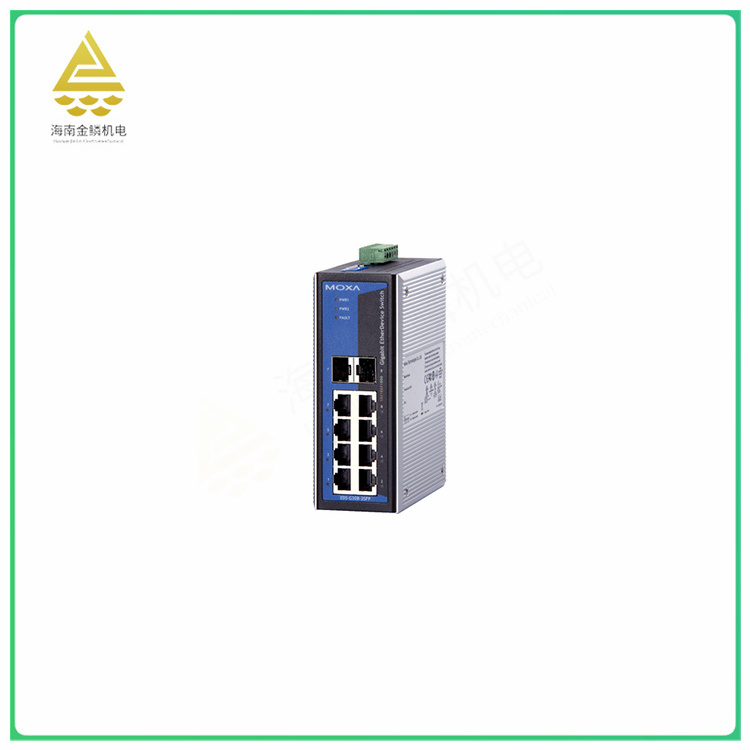
The EDS-G308-2SFP is an Ethernet switch that belongs to the EDS family. It has a variety of functions and applications and is often used in the field of industrial automation.
First of all, the EDS-G308-2SFP Ethernet switch has high-speed data transmission capabilities and supports Gigabit Ethernet rates, which can achieve efficient and stable data exchange. It supports multiple port types, such as Ethernet ports and optical fiber ports, which can be selected and configured based on actual requirements.
Secondly, EDS-G308-2SFP has a variety of protection functions, such as overcurrent protection, overvoltage protection, undervoltage protection, etc., to ensure the normal operation and safety of the equipment. At the same time, the switch also supports ring network redundancy, which can realize fast switching when the network fails, and ensure the stability and reliability of the network.
In addition, EDS-G308-2SFP Ethernet switches also have flexible expansion capabilities, support multiple module expansion slots, can expand a variety of different functional modules, such as firewall modules, voice modules, etc., to meet the different needs of users.
In summary, the EDS-G308-2SFP Ethernet switch is a high-performance, highly stable Ethernet switch, which is suitable for data transmission and control of various industrial automation equipment and systems. It has high-speed data transmission capability, a variety of protection functions and flexible expansion capabilities, which can provide efficient and reliable data exchange and transmission to ensure the normal operation and security of the equipment.
The EDS-G308-2SFP Ethernet switch has a variety of protection features, including but not limited to the following:
Overcurrent protection: prevents excessive current from damaging the device.
Overvoltage protection: prevents the device from being damaged due to high voltage.
Undervoltage protection: prevents the device from working properly due to low voltage.
Ring network redundancy: It can realize fast switching when the network fails to ensure the stability and reliability of the network.
These protection functions can ensure the normal operation and safety of the device, and improve the reliability and service life of the device.