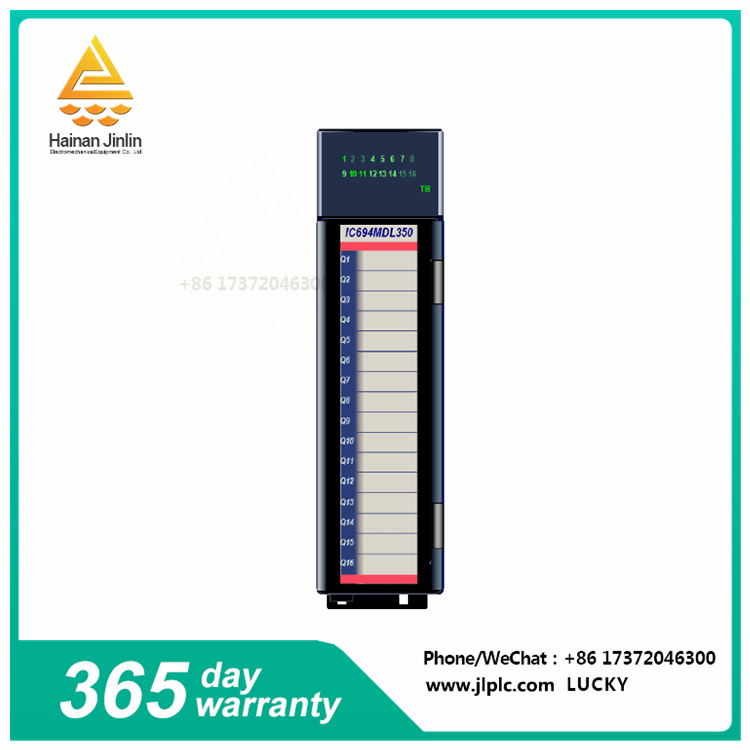
The IC694MDL350 is a product model associated with the field of industrial automation and control, which is often associated with the General Electric (GE) brand. Although the specific functions, features, and application areas may vary depending on the product version and the actual application scenario, I can provide some general information.
First, the IC694MDL350 is a module or component for functions such as signal processing, logic control, or communication interfaces in industrial automation and control systems. It may have high-speed processing capabilities, precise control functions, and compatibility with other devices and systems to meet the needs of complex industrial applications.
In terms of features, the IC694MDL350 features high reliability, high performance and easy integration. It may undergo rigorous quality control and testing to ensure stable and reliable operation in a variety of industrial environments. At the same time, it may provide standardized interfaces and communication protocols to facilitate users to integrate them into existing control systems.
As for the application field, the IC694MDL350 is widely used in various industrial automation and control systems, including but not limited to production line control, process control, energy management and other fields. It can be used with various sensors, actuators, PLC (programmable logic controller) and other equipment to achieve the monitoring, control and optimization of industrial processes.
Programming language standardization: The IEC61131-3 standard defines five programming languages, including enumeration, control program language (whose syntax is similar to PLC), structured text (similar to BASIC), function blocks (using picture ICONS), and appropriate standard libraries. The standardization of these languages enables the development of control systems to be more standardized and makes it easy for technicians to switch between different manufacturers.
Programming environment standardization: In addition to programming languages, the standard also specifies standards for programming environments, including file structure and program organization, programming task management, alarm management, data management, user interfaces, and programming language extensions. Such standardized design helps to ensure the consistency and portability of the programming environment of the control system.
Program portability: The main objective of the IEC61131-3 standard is to enable the development of control system programs to be easily portable between different control systems. This helps reduce development time and costs, and increases system flexibility and reusability.
Technician friendly: Since IEC61131-3 is based on international standards, it makes it easier for technicians to understand and use control systems provided by different manufacturers. This facilitates technology exchange and knowledge sharing.
Consistency of program information: The standard also provides consistency for the collection and distribution of program information, helping to ensure the management and maintenance of information throughout the life cycle of the control system.
In general, the functional requirements of the IEC61131-3 standard are mainly reflected in the standardization of programming languages and programming environments, as well as the portability of procedures and technical friendliness. These requirements help to improve the development efficiency, reliability and maintainability of control systems.