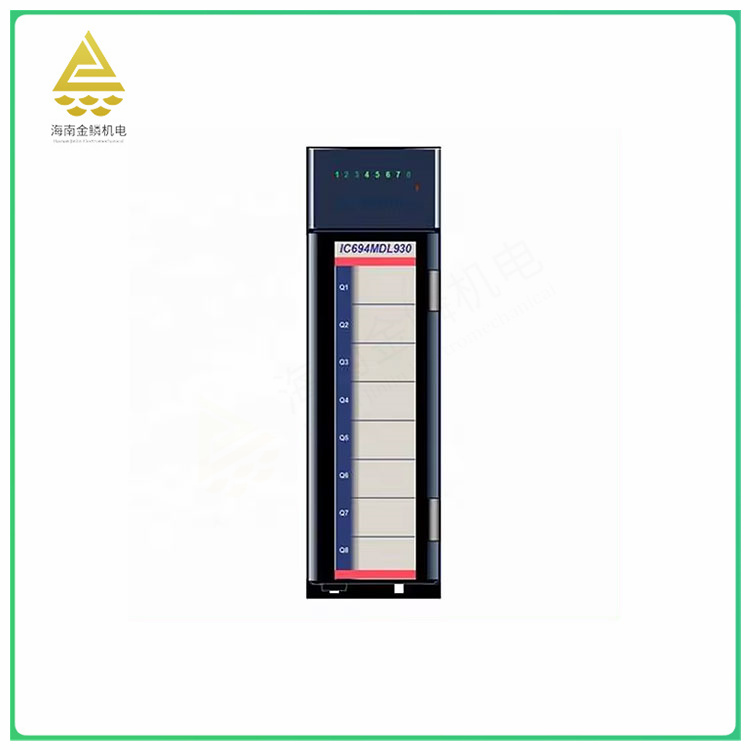
The IC694MDL930 is an Ethernet switch module from General Electric, designed for use with PACSystems RX3i and RX7i Programmable Automation controllers (PACs). This module provides Ethernet communication capabilities for connecting PAC systems with other network devices and systems.
Features:
Ethernet communication: IC694MDL930 provides a number of Ethernet ports, supporting a variety of Ethernet communication protocols, such as TCP/IP, UDP, etc., to achieve data exchange and communication between PAC system and other network devices.
Network management: This module may support network management functions, such as port configuration, VLAN allocation, and traffic control, to help users better manage and optimize network performance.
Security: To ensure network security, the module may provide security features such as firewalls, access control lists (ACLs) to prevent unauthorized access and data leaks.
Redundancy and fault tolerance: To improve system reliability and fault tolerance, the IC694MDL930 may support redundancy. That is, when the primary switch fails, the standby switch can automatically take over the network to ensure continuous system operation.
Features:
High performance: The module adopts high-speed Ethernet technology, has the characteristics of high bandwidth and low latency, and can meet the needs of industrial automation system for real-time communication.
Flexibility: The module supports multiple network configurations and communication protocols, and can be flexibly configured according to specific application scenarios and system requirements.
Reliability: After rigorous testing and verification, the module performs well in harsh industrial environments with high reliability.
Easy integration: The modules are compact, easy to install and integrate into PACSystems, and can be seamlessly integrated with other GE automation solutions.
Scope of application:
The IC694MDL930 has a wide range of applications and is suitable for industrial automation scenarios where PAC systems need to communicate with other network devices and systems. Specific application areas include:
Discrete manufacturing: such as automobile manufacturing, electronic equipment production and other scenarios that need to achieve communication and data exchange between devices.
Process control: suitable for petrochemical, water treatment, food processing and other continuous production process automation control system.
Factory automation: Used to connect various automation systems and equipment within the factory to achieve the integration and sharing of information.
Intelligent building: such as building automation, security systems, etc., need to achieve communication and control between equipment in the building.