The IS200DTAIH1ACC is a turbine control board for a variety of industrial applications such as power generation, oil and gas, chemical and pharmaceutical. It is a microprocessor expansion board manufactured and designed by General Electric as part of the Mark IV control system. A microprocessor expansion board is a device used to extend the functionality of a microprocessor-based system. In turbine control systems, microprocessor expansion boards can be used to add additional input/output (I/O) functions to the control system. Turbine control systems typically use microprocessors to control the operation of the turbine, and microprocessor expansion boards can be used to add additional I/O capabilities to the system, allowing more sensors and actuators to be connected. For example, the microprocessor expansion board can be used to add additional temperature sensors to the turbine control system.
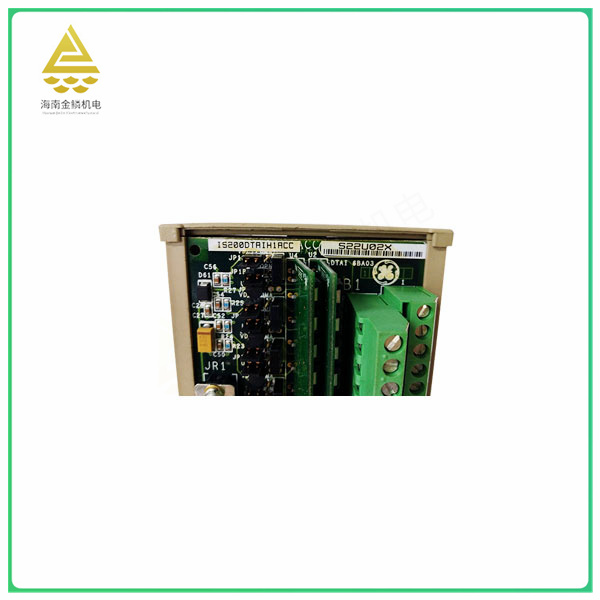
IS200DTAIH1ACC is a top-level file design algorithm, written in Verilog HDL language. Its main functions include the acquisition, processing and control of signals, as well as the operation of turbine start-stop, load regulation and protection.
First of all, IS200DTAIH1ACC has strong signal processing capability. Through the A/D control module, it can control the ADS8364 chip for sampling, so as to obtain real-time data of voltage and current. These data are then fed into the Clarke transform module and the three-phase PLL module for the necessary transformation and demodulation.
Secondly, IS200DTAIH1ACC has powerful control function. DSP outputs ud and uq through PI regulator, gets uα and uβ after Park transformation, and sends them into SVPWM module. In this module, accurate PWM waveform can be generated by sector judgment and vector action time calculation to control the operation of the turbine.
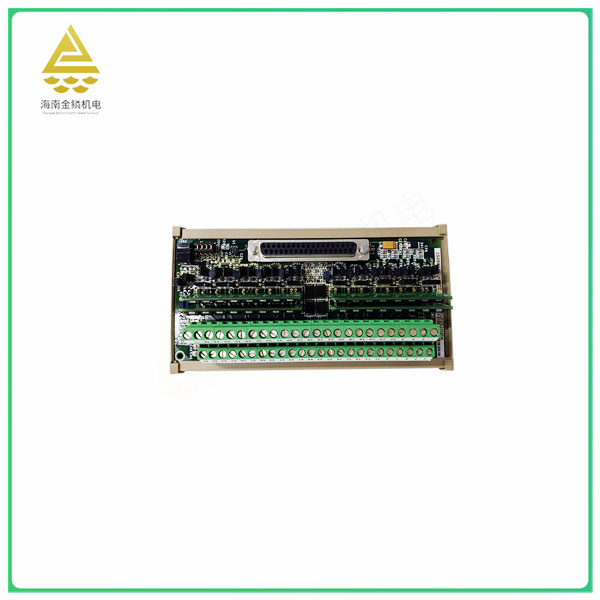
In addition, in order to prevent the overmodulation phenomenon from distorting the output voltage waveform, IS200DTAIH1ACC is equipped with the overmodulation module using the proportional reduction algorithm. At the same time, the dead zone control module is added in order to avoid the straight-through between the upper and lower bridge arms. The addition of these modules significantly improves the stability and reliability of the system.
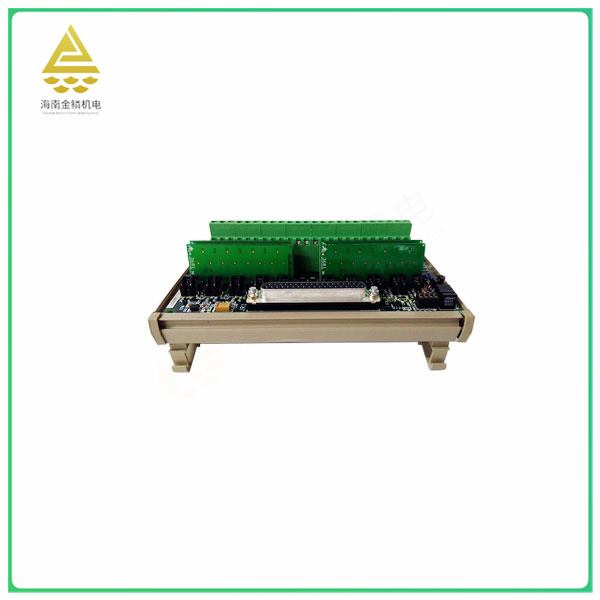
The test results show that the current harmonic distortion rate (THD) of the generator reaches 2.94% at full load, which is less than 5% of the national standard. This shows that the system has good grid-connection characteristics, and the impact of grid-connection on the power grid is small. In addition, in the sub-synchronous operation state, the power of the generator is 200kW, and the torque of the generator is T=11698N·m, so the system has good steady-state characteristics.
In summary, IS200DTAIH1ACC has powerful signal processing and control functions, and its excellent performance and stability make it have a wide range of application prospects in industrial applications.


 In addition, in order to prevent the overmodulation phenomenon from distorting the output voltage waveform, IS200DTAIH1ACC is equipped with the overmodulation module using the proportional reduction algorithm. At the same time, the dead zone control module is added in order to avoid the straight-through between the upper and lower bridge arms. The addition of these modules significantly improves the stability and reliability of the system.


