The IS220PTURH1B is a General Electric (GE) component developed for the Mark VI system and is a single-trip component for primary steam turbines.
This component provides an electrical interface between the turbine control terminal board and one or two Ethernet cables. The output of this component is achieved through a DC 62-pin connector connected to the associated terminal board.
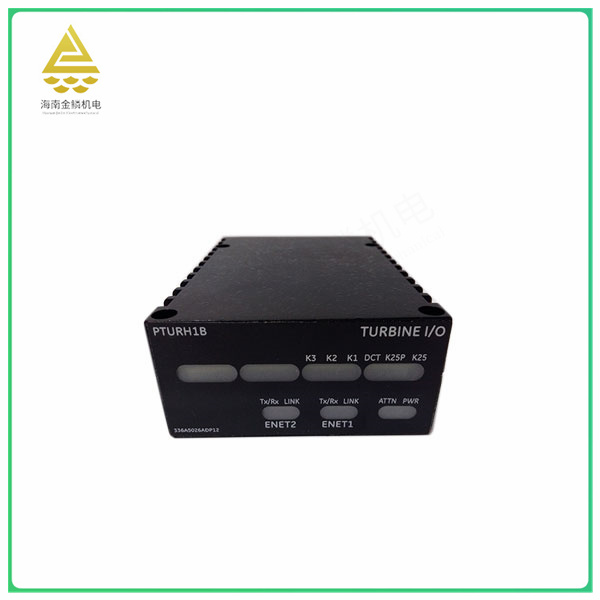
The IS220PTURH1B comes in a black housing with an air outlet. The front of this case has multiple LED indicators, as well as an IR (infrared port). This port is not used in this package. Inside this enclosure, there is a processor board, a second board dedicated to turbine control, and an analog acquisition auxiliary board. The battery string is installed on the TTURH1C terminal board.
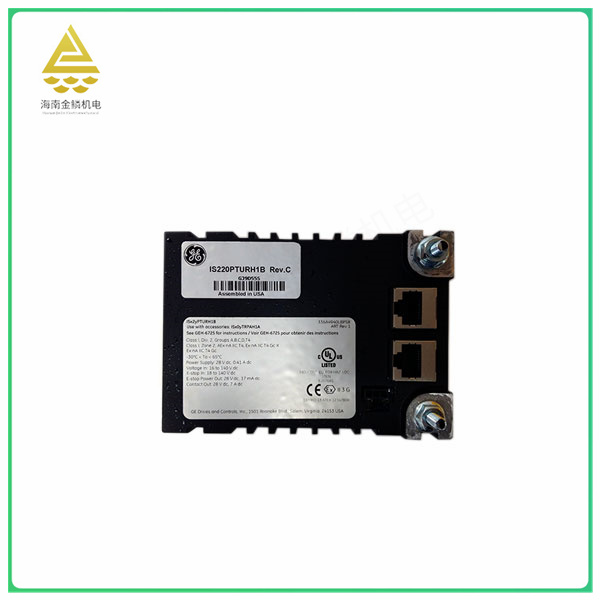
The processor board has two 10/100 Ethernet ports, flash memory and RAM, a read-only chip for identification, an internal temperature sensor, and a reset circuit. The IS220PTURH1B allows automatic reconfiguration and automatically downloads I/O packages from the controller.
The IS220PTURH1B has an interface with four passive magnetic speed inputs.
GE IS220PTURH1 B Product Details:
Analog input: The GE IS220PTURH1B analog input module is used to receive analog signals and convert them into digital signals for the control system to process and monitor.
Number of channels: This module will typically have multiple independent analog input channels, each of which can be configured and monitored independently.
Signal type: Different types of analog signals are usually accepted, such as analog current (such as 4-20 mA) or analog voltage (such as 0-10V).
Accuracy: The accuracy of the GE IS220PTURH1B analog input module will usually vary depending on the specific model, but high precision is usually required to ensure accurate measurements.
Communication interface: The GE IS220PTURH1B analog input module will usually have an appropriate communication interface to transmit data to the master control system.
Electrical isolation: To ensure system security, modules often have electrical isolation to isolate analog input signals from other signals.
Programmability: Some modules may have a degree of programmability that allows you to configure and adjust in a particular application.
Industry standards: These modules usually comply with industry I standards to ensure stable operation in a variety of environments and applications.
The advantages of IS220PTURH1B may include:
High reliability: After strict quality control and testing, the component has high reliability and stability, which can ensure the stable operation of the gas turbine system.
Easy integration: It can be easily integrated into the Mark VI control system, reducing the complexity and maintenance costs of the system.
High precision: It can accurately monitor and control the operating status and parameters of the gas turbine to ensure that it operates in the best condition.
Disadvantages of IS220PTURH1B may include:
Higher cost: Relative to other similar products, IS220PTURH1B has a higher price, which may increase the cost of the entire system.
Complex debugging: The debugging process of this component is relatively complex, requiring professional technical personnel to operate and maintain.
Applications for IS220PTURH1B may include:
Gas turbine control system: Used to monitor and control the operating status and parameters of the gas turbine to ensure its optimal operation.
Power plant monitoring system: used to monitor and control the operating status and parameters of the power plant to ensure its stable and efficient operation.
Energy management field: used to monitor and control energy consumption and utilization, improve energy efficiency.
It should be noted that the functions and application fields of different products may be different due to specific application scenarios and needs, so it is necessary to evaluate and select according to the actual situation in the use process. At the same time, in order to ensure the safe and stable operation of the system, it is also necessary to carry out regular maintenance and inspection.


