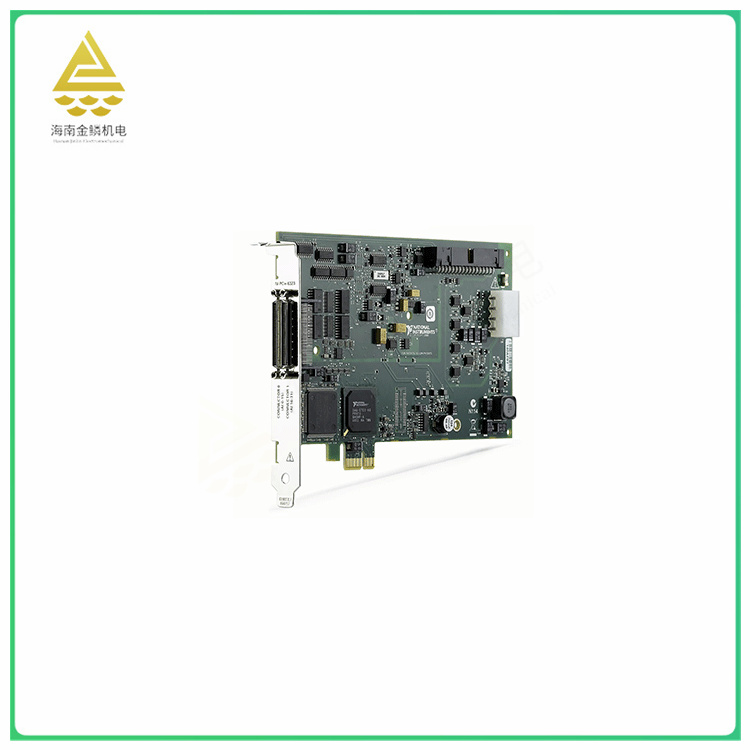
PCI Express, 32-way AI (16-bit, 250 kS/ s), 4-way AO (900 kS/ s), 48-way DIO Multi-function I/O device PCIe 6323 provides analog I/O, digital I/O, and four 32-bit counters/timers. Used for PWM, encoder, frequency, event counting, etc. The device utilizes a high-throughput PCI Express bus and multi-core optimized drivers and application software to deliver high performance.
The PCI-6323 is a multi-function I/O device from National Instruments that provides a combination of analog I/O, digital I/O, and counter/timer functions in one device. Specifically, the device has 32 analog inputs, a sampling rate of up to 250 kS/s, a 16-bit resolution, and a voltage range of ±10 V; 4 analog outputs, output rate of 900 kS/s, 16-bit resolution, voltage range of ±10 V; 48 digital I/O lines, 32 of which are 1 MHz hardware timing lines; As well as 4-channel 32-bit counter/timer for PWM, encoder, frequency, event counting and other applications.
In addition, the PCI-6323 is equipped with NI-STC3 timing and synchronization technology, supports Windows 7/Vista/XP/2000 operating systems, and optimizes performance through the high processing power PCI Express bus. This makes it ideal for a variety of industrial applications such as laboratory automation, research and design validation.
The advantages and disadvantages of PowerPCI-E (or PCI Express, PCIe for short) are as follows:
Advantages:
High-speed transfer: PowerPCI-E provides higher data transfer rates than traditional PCI. This allows it to process large amounts of data more efficiently, which improves the overall performance of the system.
Two-way communication: PowerPCI-E supports two-way communication, allowing the device to send and receive data at the same time, further improving data transmission efficiency.
Low latency: Because PowerPCI-E uses a point-to-point serial connection, each device has its own dedicated connection and does not need to request broadband to the entire bus, so the latency of data transmission can be reduced.
Hot Swap support: PowerPCI-E supports hot swap, which means that devices can be safely added or removed while the device is running without shutting down the system.
Energy saving: PowerPCI-E uses advanced power management features to effectively reduce the power consumption of the device, thus achieving energy saving.
Cons:
Higher cost: Due to the advanced technology and high-speed transmission capabilities of PowerPCI-E, its manufacturing costs are generally higher than traditional PCI, so it can lead to higher equipment prices.
Compatibility issues: Although PowerPCI-E has gradually become a mainstream interface standard, there are still some older devices that may not support it. This may lead to the need to use a traditional PCI interface in some cases.
Security concerns: While PowerPCI-E employs a variety of security mechanisms to ensure the security of data transmission, in some cases, there may still be security risks. For example, if the malware is able to access the PCIe bus, it could steal sensitive data or interfere with the proper operation of other devices.