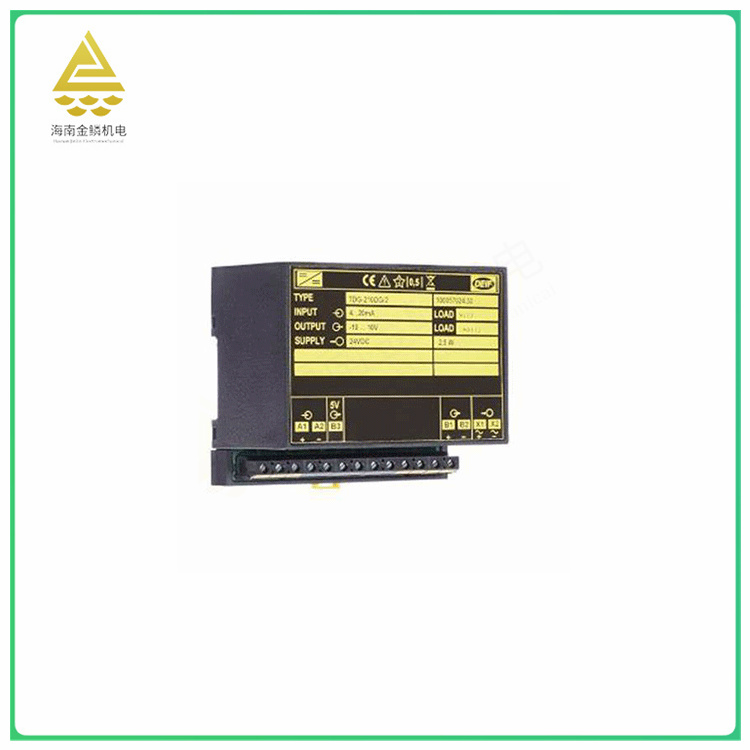
The TDG-210DG2 is a distributed I/O module commonly used in the field of industrial automation. This module belongs to ABB's Transmitter Distributed Gateway (TDG) family and is mainly used for remote I/O communication and data processing.
Main features:
Communication capability: TDG-210DG2 supports a variety of communication protocols such as PROFIBUS DP, PROFINET IO, etc., making it possible to seamlessly connect and exchange data with a variety of devices and systems.
Distributed I/O: This module allows input/output (I/O) functions to be distributed to different locations, thereby reducing the burden on the host controller and increasing the flexibility and scalability of the system.
Data processing: The TDG-210DG2 can process data locally, reducing the communication need for the master controller and improving the response speed and efficiency of the system.
Diagnostic function: The module has a powerful diagnostic function, can detect and report various faults and abnormal situations, help users quickly locate and solve problems.
Easy configuration and maintenance: TDG-210DG2 supports a variety of configuration tools and methods, enabling users to easily configure modules and set parameters. At the same time, its modular design makes maintenance and replacement easy and fast.
Application scenario:
The TDG-210DG2 is suitable for a variety of industrial automation applications that require remote I/O communication and data processing, such as production line control, process flow monitoring, building automation, etc. By distributing it in different locations, real-time monitoring and control of field equipment can be realized, and the reliability and efficiency of the system can be improved.
Analysis of advantages and disadvantages:
Advantages:
Multiple communication protocols are supported and easy to integrate with other devices and systems.
Distributed I/O design improves the flexibility and scalability of the system.
The powerful data processing ability improves the response speed and efficiency of the system.
Easy to configure and maintain, reducing the user's cost.
Cons:
Additional communication equipment and cables may be required to enable remote communication.
Depending on specific communication protocols and configuration tools, there may be certain technical thresholds.
In some application scenarios, more modules may be required to implement the required I/O functions, increasing the cost.
Overall, the TDG-210DG2 is a powerful, easy to use and maintain distributed I/O module for a variety of industrial automation applications. The selection and use must be considered according to specific application scenarios and requirements.